
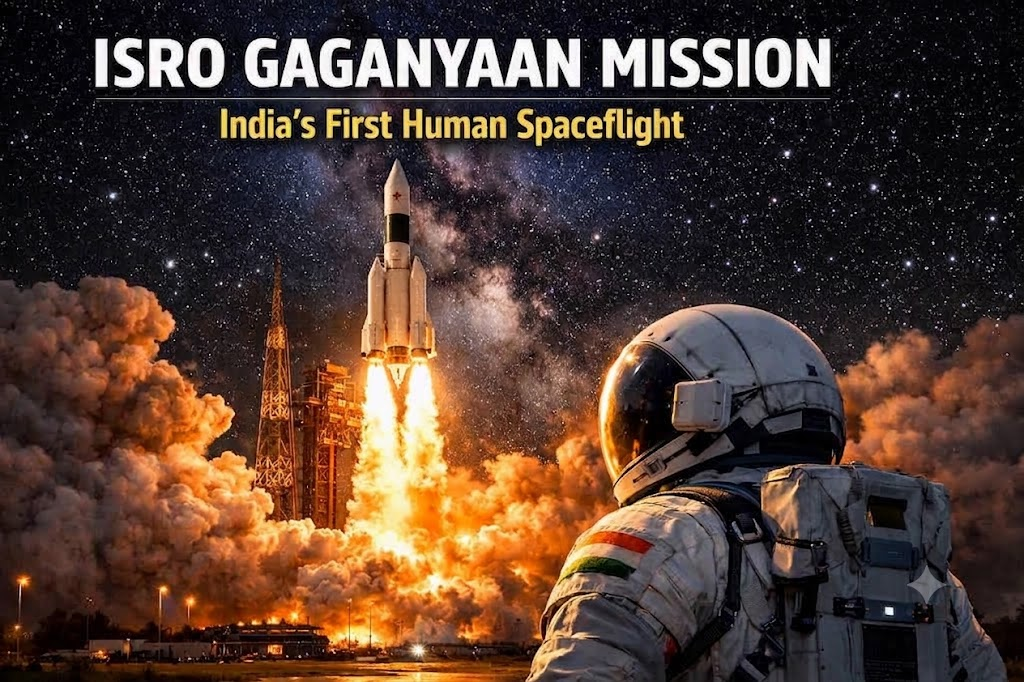
ISRO’s Gaganyaan Mission is India’s path toward becoming only the fourth nation to independently send humans into space, through the Indian Space Research Organisation’s (ISRO) ambitious programme. The mission aims to send a three-member Indian crew into Low Earth Orbit (LEO) for a multi-day mission, marking one of the most significant milestones in India’s scientific and technological history.
Gaganyaan represents years of indigenous research, testing, and innovation, and reflects India’s growing confidence in advanced space technologies and human-rated launch systems.
What Makes the Gaganyaan Mission Historic?
🚀 Would be India’s first human spaceflight mission, placing the country among a select group of spacefaring nations
🧑🚀 Indigenous Crew Module engineered with multiple layers of safety and redundancy
🔥 Crew Escape System designed to protect astronauts during any launch emergency
🌍 A Low Earth Orbit mission that lays the groundwork for India’s long-term human spaceflight roadmap
A powerful symbol of technological self-reliance and scientific ambition
Where the Mission Stands Now
ISRO has completed several critical tests to build confidence ahead of an eventual crewed flight, including a Test Vehicle Abort Mission, high-altitude Crew Escape System validation, and crew module recovery trials conducted in open-sea conditions.
The programme has been deliberately cautious about timelines. ISRO leadership has been clear that human safety, not speed, is driving every decision, and the schedule for the uncrewed test flights that must precede any crewed launch continues to be reviewed and adjusted as testing progresses. Rather than rushing toward a fixed date, ISRO is running through a planned sequence of uncrewed missions first, with the crewed flight to follow only once those results are in.
Why the Careful Timeline Matters
A programme of this scale, involving a human-rated launch vehicle, life-support systems, orbital operations, and crew safety protocols, is inherently technology-intensive. ISRO has pointed to lessons from other space agencies’ safety setbacks as part of why it has expanded its uncrewed test programme rather than compress it.
Once the crewed flight succeeds, it will let India confidently plan more advanced missions, including longer-duration human spaceflight, orbital infrastructure development, and deeper interplanetary exploration, while reducing dependence on foreign space agencies.
Why the Gaganyaan Mission Matters for India
Beyond national pride, ISRO’s Gaganyaan Mission is opening opportunities across multiple domains: advancement of human spaceflight technologies, growth in space science and microgravity research, a stronger global position in space exploration, and expansion of India’s space-tech and aerospace employment ecosystem.
How Gaganyaan Lays the Foundation for India’s Future Space Station
Gaganyaan is widely seen as the first major step toward India’s own space station programme. Human spaceflight capability is essential for conducting long-duration experiments, testing advanced materials, and preparing astronauts for extended missions. The technologies being validated through Gaganyaan, such as astronaut training, orbital mission management, and safe crew recovery, will directly support future Indian orbital laboratories and international collaborations.
Career and Research Opportunities
The Gaganyaan programme is expected to accelerate demand for skilled professionals in aerospace engineering and spacecraft design, human physiology and space medicine, artificial intelligence and autonomous systems, and space robotics and mission control operations. It’s also encouraging private-sector participation and startups in India’s growing space-tech ecosystem, opening new pathways for students, researchers, and innovators.
Expert Insight: Human spaceflight programmes often act as force multipliers for innovation. Countries that master crewed space missions typically see rapid growth in satellite technology, defence applications, and commercial space industries within a decade.
What’s Next?
Before any Indian astronaut goes to space, ISRO must complete its planned series of unmanned test flights to validate mission readiness and system reliability. The programme has already seen its timeline shift more than once, a reminder that human spaceflight development rarely moves on a fixed schedule. What’s certain is the direction: India is steadily building toward a historic first, one careful test at a time.
🔗 Explore More
India’s Space Missions