
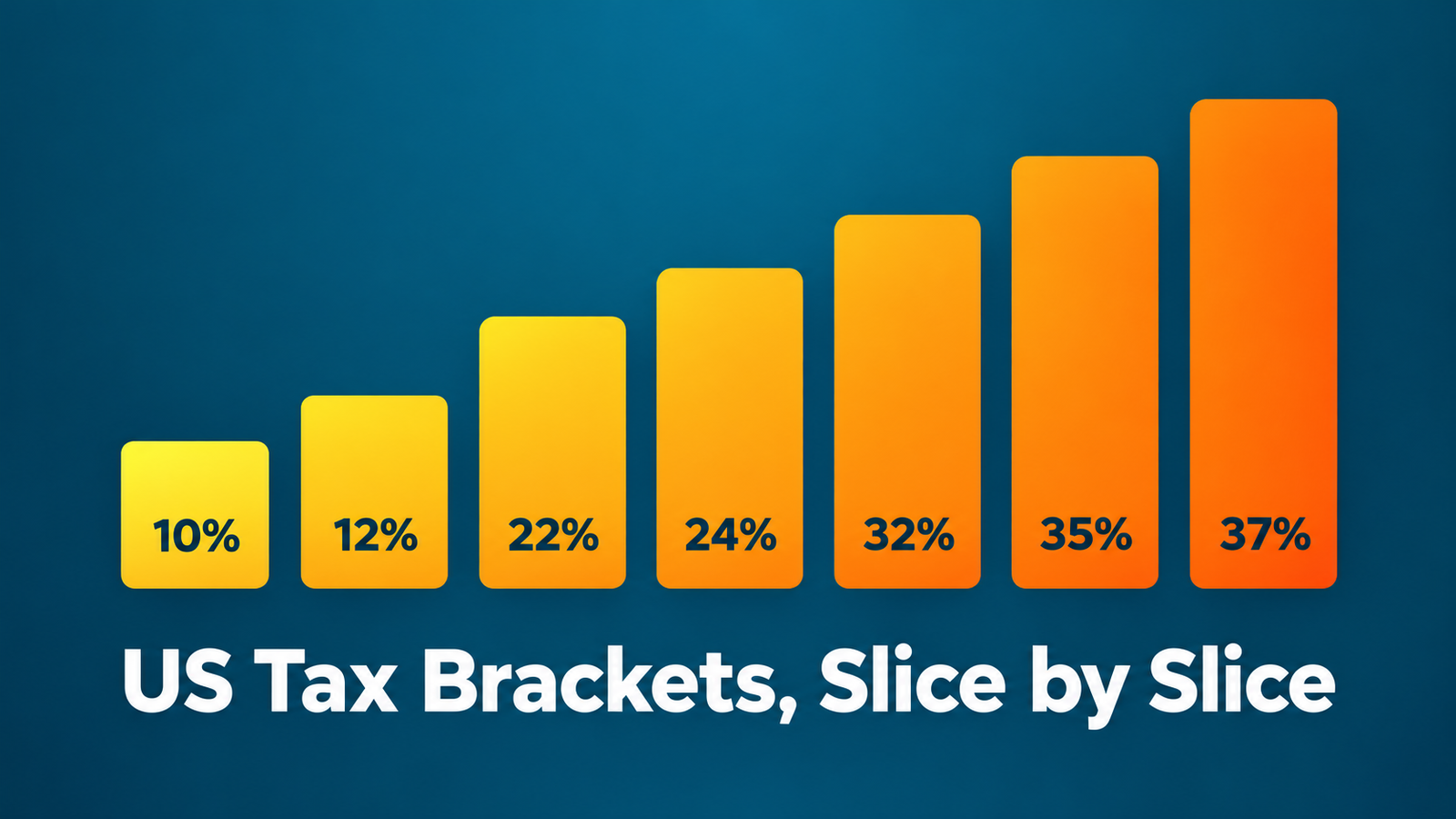
Last updated: October 21, 2026. The worked example uses US federal income tax for the 2026 tax year (single filers). A comparison with the UK, Canada and Australia follows further down.
How do tax brackets work? Many people believe that when they earn more and cross into a higher bracket, all of their income is suddenly taxed at that higher rate. That is not true, and it is one of the most common money myths everywhere. In this guide you will learn how the system really works, see a simple worked example with a table, and understand why a raise does not shrink your take-home pay because of brackets.
How Do Tax Brackets Work in the US?
The US uses a progressive income tax system. Your income is split into slices, and each slice is taxed at its own rate. The first slice is taxed at the lowest rate, the next slice at a slightly higher rate, and so on. Only the part of your income that falls inside a bracket is taxed at that bracket’s rate.
Think of it like filling buckets with water. The first bucket fills up and overflows into the second, then the third. Each bucket has its own price. You pay the low price for the first bucket even if you end up filling three buckets.
The 2026 Federal Tax Brackets for Single Filers
Here are the seven federal brackets for single filers for the 2026 tax year. The amounts refer to taxable income, which is your income after deductions.
| Tax rate | Taxable income (single filer) |
|---|---|
| 10% | Up to $12,400 |
| 12% | $12,401 to $50,400 |
| 22% | $50,401 to $105,700 |
| 24% | $105,701 to $201,775 |
| 32% | $201,776 to $256,225 |
| 35% | $256,226 to $640,600 |
| 37% | Over $640,600 |
Married couples filing jointly and heads of household have different, wider brackets. The IRS adjusts these limits for inflation every year, so always confirm the current numbers on the official IRS page on federal income tax rates and brackets before you file.
Marginal Tax Rate vs Effective Tax Rate
What is your marginal tax rate?
Your marginal tax rate is the rate on your last dollar of income, which is the top bracket your income reaches. It tells you how much tax you pay on the next dollar you earn, for example from a raise, a bonus or side income.
What is your effective tax rate?
Your effective tax rate is your total tax divided by your total taxable income. Because the lower slices are taxed at lower rates, your effective rate is always lower than your marginal rate.
A Simple Worked Example: $60,000 of Taxable Income
Suppose you are a single filer with $60,000 of taxable income. Here is how the tax is calculated, slice by slice.
| Slice | Income in this slice | Rate | Tax |
|---|---|---|---|
| First | $12,400 | 10% | $1,240 |
| Second | $38,000 | 12% | $4,560 |
| Third | $9,600 | 22% | $2,112 |
| Total | $60,000 | $7,912 |
Your marginal rate is 22%, because your top slice falls in the 22% bracket. But your effective rate is only about 13.2% ($7,912 divided by $60,000). That gap is the whole point: most of your income was taxed at just 10% and 12%.
Can a Raise Lower Your Take-Home Pay?
No. If a raise pushes part of your income into the next bracket, only the extra dollars above the line are taxed at the higher rate. Imagine your taxable income rises from $50,000 to $51,400. Only the $1,000 above $50,400 is taxed at 22%, which is $220. The rest of your income is taxed exactly as before. A raise always leaves you with more money, not less.
One caution: some tax credits and benefits do phase out as income rises, so check those separately from the brackets.
Taxable Income vs Gross Income
Brackets apply to taxable income, not to your full salary. You start with gross income, subtract the standard deduction (or itemized deductions) and certain adjustments, and the result is your taxable income. For the 2026 tax year, the standard deduction for single filers is $16,100, so a $76,100 salary with no other adjustments would give $60,000 of taxable income.
This is why retirement savings are so powerful. Money you put into a traditional 401(k) usually lowers your taxable income today. Read our guide to the 401(k) employer match and compare accounts in Roth IRA vs Traditional IRA to see which tax treatment suits you.
Tax Brackets in the US, UK, Canada and Australia Compared (2026)
The idea behind tax brackets is not limited to the US. The US, UK, Canada and Australia all use progressive systems, so in every one of them only the income inside a bracket is taxed at that bracket’s rate, and a raise cannot reduce your take-home pay. What differs is the number of brackets, the rates, the tax-free amount and the tax year. Here is a side-by-side look at national income tax for a single resident taxpayer.
| Country | Tax year | Tax-free amount | National rates and income limits |
|---|---|---|---|
| United States (federal) | Calendar year 2026 | $16,100 standard deduction | 10% up to $12,400; 12% to $50,400; 22% to $105,700; 24% to $201,775; 32% to $256,225; 35% to $640,600; 37% above |
| United Kingdom (England, Wales, Northern Ireland) | 6 April 2026 to 5 April 2027 | £12,570 Personal Allowance | 20% to £50,270; 40% to £125,140; 45% above |
| Canada (federal) | Calendar year 2026 | $16,452 basic personal amount | 14% up to $58,523; 20.5% to $117,045; 26% to $181,440; 29% to $258,482; 33% above |
| Australia (residents) | 1 July 2026 to 30 June 2027 | $18,200 tax-free threshold | 15% to $45,000; 30% to $135,000; 37% to $190,000; 45% above |
A few important points when you read this table:
- The US and Canada also charge state or provincial income tax on top of the federal rates. Australia adds a 2% Medicare levy for most residents. Scotland sets its own income tax bands inside the UK.
- Amounts are in each country’s own currency (US dollars, pounds, Canadian dollars and Australian dollars), so do not compare the numbers directly.
- UK example: on a £60,000 income outside Scotland, £12,570 is tax-free, £37,700 is taxed at 20% and the remaining £9,730 at 40%. That is £11,432 of income tax, an average rate of about 19% even though the top slice is taxed at 40%. National Insurance is separate.
Whichever country you live in, the lesson is the same: your top rate applies only to the top slice. Always confirm the current figures with your own tax authority: the IRS in the US, HMRC in the UK, the CRA in Canada or the ATO in Australia.
Common Tax Bracket Myths
Myth 1: Moving into a higher bracket means you lose money
False. Only the income inside the new bracket is taxed at the higher rate, so your total take-home pay still goes up.
Myth 2: Your whole income is taxed at your top rate
False. Every slice has its own rate, which is why your effective rate is lower than your top bracket.
Myth 3: Your bracket is your tax rate
Not quite. Your bracket is your marginal rate. Your real average rate, the effective rate, is almost always lower.
How to Use Tax Brackets in Your Money Planning
- Know your marginal rate. It shows what each extra dollar of income or each pre-tax contribution is worth.
- Use pre-tax accounts wisely. Contributions to a traditional 401(k) or IRA can lower your taxable income.
- Do not fear bonuses. Withholding on a bonus can look high, but your real tax is settled when you file.
- Keep your base strong. Build an emergency fund, follow the 50/30/20 budget rule and track your net worth so tax savings actually turn into wealth.
Frequently Asked Questions
Are tax brackets the same for everyone?
The rates (10% to 37%) are the same, but the income ranges depend on your filing status: single, married filing jointly, married filing separately or head of household.
Do state taxes use the same brackets?
No. Federal brackets apply only to federal income tax. Each state sets its own rules, and some states have no income tax at all.
Does the bracket apply to my salary or my taxable income?
It applies to taxable income, which is what remains after the standard or itemized deduction and other adjustments.
Final Thoughts
Tax brackets are slices, not cliffs. Only the income inside each bracket is taxed at that bracket’s rate, your effective rate is lower than your marginal rate, and a raise never reduces your take-home pay. Once you understand this, you can plan raises, bonuses and retirement contributions with confidence instead of fear.
Disclaimer: This article is for general education only and is not tax, legal or financial advice. Tax rules and limits change, so confirm current figures with the IRS or a qualified tax professional before making decisions.