
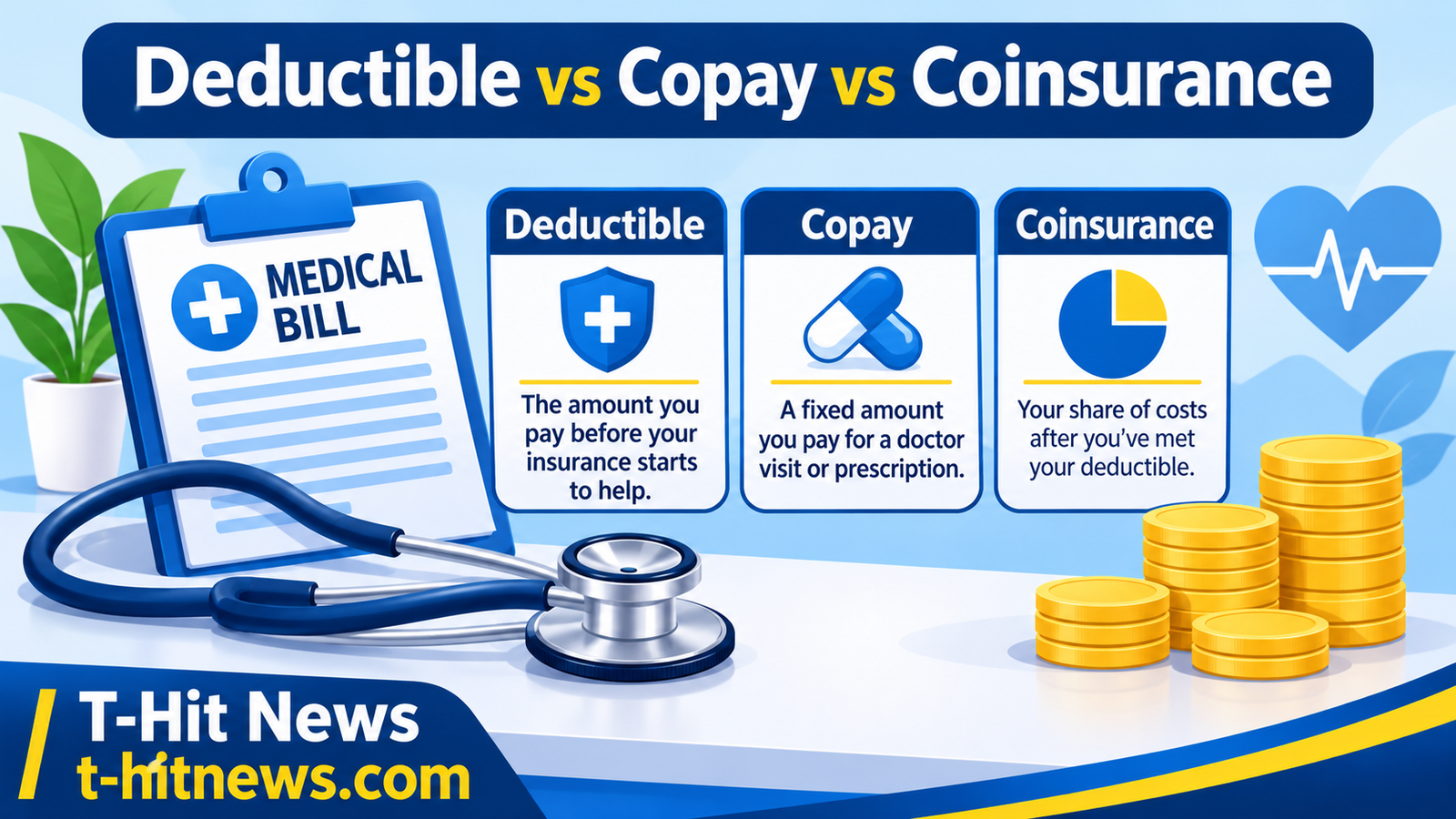
Deductible vs copay vs coinsurance is the comparison that trips up almost everyone the first time a health insurance bill arrives. All three are ways you share the cost of care with your insurer, but each one works at a different moment and in a different way. This guide explains them in plain English, adds them up on one example bill, and gives you a simple check to use before choosing any plan.
If you want the bigger picture first, read our guide on how health insurance works, which covers premiums and the out-of-pocket maximum. Here we go deeper on the three cost-sharing terms.
The Short Answer
- Deductible: the amount you pay yourself first, before the plan starts paying most costs.
- Copay: a fixed fee for one service, such as $30 for a doctor visit.
- Coinsurance: a percentage of the cost you pay after the deductible is met, such as 20%.
What Is a Deductible?
A deductible is the yearly amount you must pay for covered care before your insurance begins to share the cost. If your deductible is $1,500, you pay the first $1,500 of covered bills yourself. After that, your plan starts paying its share.
Why a Lower Premium Often Means a Higher Deductible
Insurers balance the monthly premium against your risk. A plan with a cheap premium usually has a higher deductible, so you pay more when you actually need care. A plan with a higher premium usually has a lower deductible. Neither is automatically better; it depends on how often you expect to use care.
Does the Deductible Reset?
On most plans the deductible resets every year, so you start again at zero. Check whether your plan year follows the calendar year or a different start date.
What Is a Copay?
A copay (short for copayment) is a flat dollar amount you pay at the time of a specific service. Typical examples are a doctor visit, a specialist visit, an urgent care visit or a prescription. Because the amount is fixed, copays are easy to predict. Many plans charge copays for routine visits even before the deductible is met, but this varies, so read your plan summary.
What Is Coinsurance?
Coinsurance is your percentage share of a covered bill after the deductible is met. It is usually written as two numbers, such as 80/20. In that case the plan pays 80% and you pay 20%. Coinsurance is where big bills grow quickly, because 20% of a large hospital bill is still a large number. For an official definition, see the HealthCare.gov glossary entry on coinsurance.
Deductible vs Copay vs Coinsurance: Comparison Table
| Term | What it is | When you pay | Example |
|---|---|---|---|
| Deductible | Fixed yearly amount you pay first | Before the plan pays most costs | First $1,500 of covered care |
| Copay | Flat fee for one service | At the visit, every time | $30 doctor visit |
| Coinsurance | Percentage share of the bill | After the deductible is met | 20% of the remaining bill |
One Bill, Three Terms: A Worked Example
Imagine a plan with a $1,500 deductible, 20% coinsurance, a $30 copay for doctor visits and a $6,000 out-of-pocket maximum. You need an outpatient procedure that costs $6,000 in total (all in network). Here is how the bill splits:
- Step 1 – Deductible: you pay the first $1,500.
- Step 2 – Coinsurance: the remaining $4,500 is shared. You pay 20%, which is $900.
- Step 3 – Your total: $1,500 + $900 = $2,400. The insurer pays the other $3,600.
The $30 copay for a follow-up doctor visit is a separate charge on top. Now imagine a much larger bill of $60,000. You would not pay 20% of everything. Once your share reaches the out-of-pocket maximum of $6,000, the plan pays 100% of covered in-network care for the rest of the year. That limit is the safety net behind all three terms.
Common Mistakes People Make
- Thinking the premium is part of the deductible. The premium is your monthly price for having the plan. It is separate.
- Assuming a copay always counts toward the deductible. On many plans it does not, so check your plan documents.
- Ignoring out-of-network rules. Out-of-network care often has a higher deductible and higher coinsurance.
- Choosing only by premium. A cheap premium with a very high deductible can cost more in a bad year.
A Simple 3-Question Check Before You Choose a Plan
- How much could I pay in a bad year? Look at the deductible plus the out-of-pocket maximum.
- How often do I use care? Frequent visits favour lower deductibles and clear copays.
- Do I have a tax-advantaged account? A health savings account (HSA) or an FSA can pay these costs with pre-tax money.
The same ideas appear outside people’s health plans too. Pet policies also use deductibles and percentage reimbursement, which we cover in our guide on whether pet insurance is worth it.
Frequently Asked Questions
Is a copay the same as a deductible?
No. A deductible is a yearly amount you pay before the plan shares costs. A copay is a flat fee for a single service.
Can I pay a copay and coinsurance on the same visit?
It depends on the plan. Some plans charge a copay for the visit and coinsurance for extra services such as tests or procedures.
Is a higher deductible better?
Not always. It lowers your premium, but you pay more before coverage begins. It suits people who rarely use care and can afford the deductible in a bad year.
Final Thoughts
Remember the order: you meet the deductible first, then share costs through coinsurance, while copays cover specific services at a fixed price, and the out-of-pocket maximum caps your yearly risk. Once you can place each term on the timeline of a bill, plan comparisons become much easier.
Disclaimer: This article is for general education only and is not financial, legal or insurance advice. Plan rules, limits and costs differ between insurers and countries. Always read your own policy documents or speak with a licensed insurance professional before deciding.