
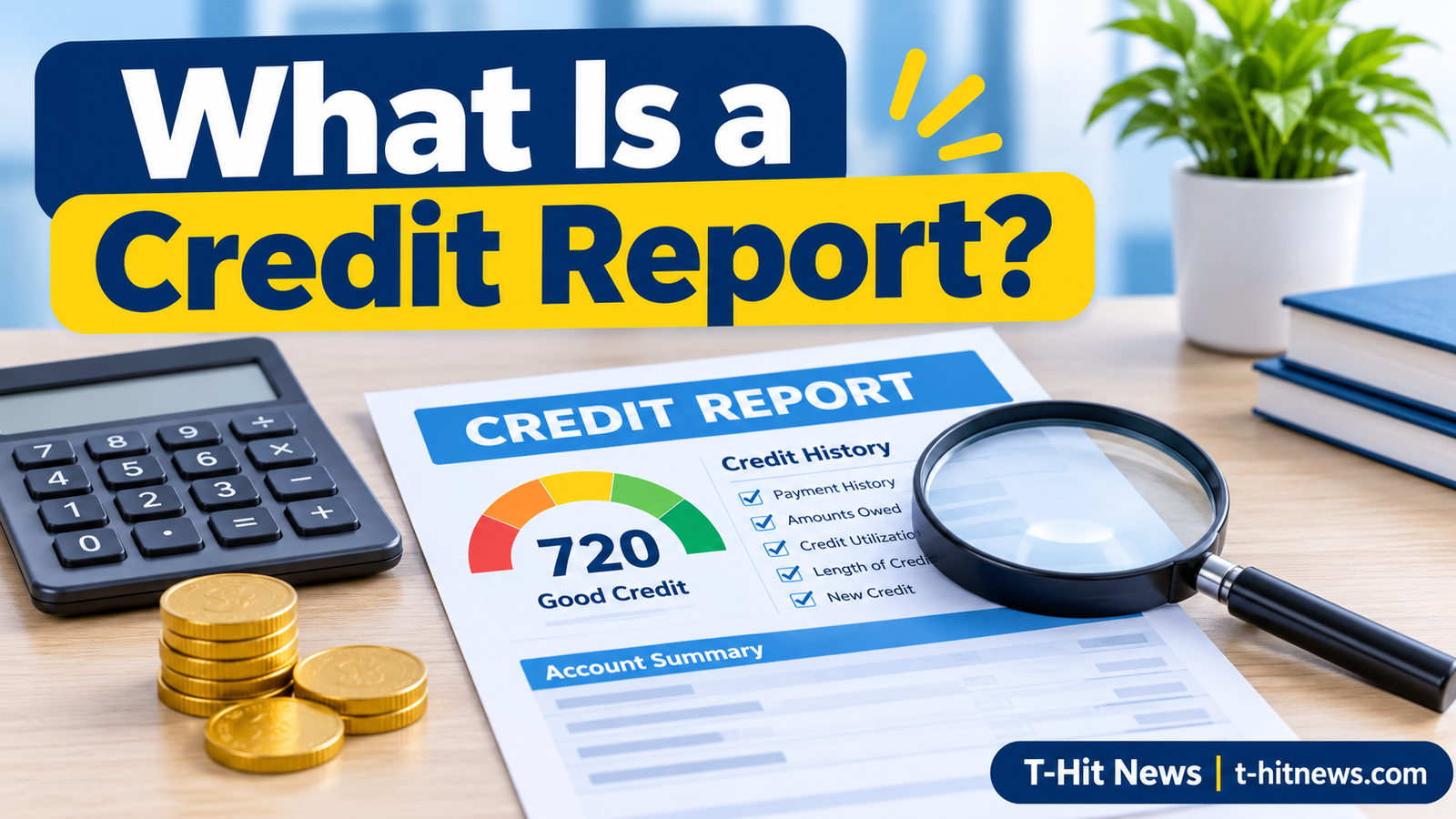
What is a credit report? It is a detailed record of how you have borrowed and repaid money over the years, kept by credit bureaus and used by lenders, landlords and sometimes employers to judge how risky it is to work with you. If you have ever applied for a credit card, a car loan or a mortgage, a credit report about you almost certainly exists, even if you have never looked at it.
This guide explains in plain language what is inside a credit report, how it differs from a credit score, how to check it for free and how to fix mistakes. It focuses on the United States system, where the rules are best defined, but the basic ideas apply in many countries.
What Is a Credit Report and Who Creates It?
A credit report is a file that lists your credit accounts and your payment behaviour. In the United States it is created by three major credit bureaus: Equifax, Experian and TransUnion. Banks, card companies and lenders send them updates about your accounts, usually every month.
Because not every lender reports to all three bureaus, your three reports can look slightly different. The bureaus only collect and store the data. They do not decide whether you get a loan. That decision always belongs to the lender.
What Information Is Inside a Credit Report?
Personal information
Your name, current and past addresses, date of birth, part of your national ID number and sometimes your employer. It does not include your income, bank balance or savings.
Credit accounts
Credit cards, auto loans, student loans and mortgages. For each account you will see the opening date, credit limit or loan amount, current balance and a month-by-month payment history. Payment history is the part lenders care about most.
Collections and public records
If an unpaid debt was sent to a collection agency, it can appear here. Bankruptcies are also listed.
Inquiries
A hard inquiry is recorded when a lender checks your report after you apply for credit. Hard inquiries can stay on your report for up to two years. A soft inquiry, such as checking your own report, is not seen by lenders and does not affect your score.
Credit Report vs Credit Score: What’s the Difference?
People often mix these two up, but they are different things.
| Point | Credit Report | Credit Score |
|---|---|---|
| What it is | A detailed history of your accounts | A number (usually 300 to 850) calculated from that history |
| Where it comes from | Credit bureaus | Scoring models such as FICO and VantageScore |
| What it shows | Accounts, balances, late payments, inquiries | A quick summary of risk |
| Can you fix errors? | Yes, by filing a dispute | Only by fixing the report behind it |
Think of the report as your full school record and the score as a single grade made from it. If the record has a mistake, the grade can be wrong too.
How to Check Your Credit Report for Free
In the United States, you can get your reports from all three bureaus at no cost through the official website AnnualCreditReport.com. Here is the simple process:
- Open AnnualCreditReport.com and choose to request your reports.
- Verify your identity by answering a few security questions.
- Select all three bureaus: Equifax, Experian and TransUnion.
- Download or save each report so you can compare them.
Checking your own report does not lower your score. If you live outside the United States, look for the national credit bureau in your country, as many countries also give you at least one free report each year.
How to Read Your Credit Report: A Simple Example
Imagine a reader named Maria who checks her three reports before applying for a car loan. She finds three problems: a credit card she closed two years ago still shows as open with a balance, a late payment on a loan she is sure she paid on time, and a collection account she does not recognise.
When you read your own report, look for these things:
- Accounts you never opened, which can be a sign of identity theft.
- Late payments that you believe were paid on time.
- Wrong balances or credit limits.
- Closed accounts still listed as open.
- Old addresses or names you have never used.
How to Fix Errors on Your Credit Report
Errors are more common than most people expect, and you have the legal right to dispute them. Here is a simple way to do it:
- Collect proof. Gather statements, receipts or letters that show the correct information.
- Dispute with the bureau. Each bureau has an online dispute form. You can also send a letter. Explain what is wrong and attach copies of your proof.
- Tell the lender too. Contact the company that reported the wrong data and ask them to correct it.
- Wait for the result. In the United States, bureaus generally have about 30 days to investigate.
- Check again. Ask for an updated report and confirm the error is gone.
Keep in mind that accurate negative information cannot be removed just because it hurts your score. It falls off by itself with time.
How Long Does Information Stay on Your Credit Report?
- Late payments and most negative items: about seven years.
- Chapter 7 bankruptcy: up to ten years.
- Hard inquiries: up to two years.
- Open accounts in good standing: they can stay as long as the account is open, and closed accounts in good standing often remain for about ten years.
Simple Habits to Keep Your Credit Report Healthy
- Pay every bill on time, even if only the minimum.
- Keep your card balances low. Our guide on the credit utilization ratio shows how to calculate it.
- Follow the steps in our guide on how to improve your credit score.
- Understand what your card really costs by reading about credit card interest.
- Apply for new credit only when you need it.
Frequently Asked Questions
Does checking my own credit report hurt my score?
No. Checking your own report is a soft inquiry and does not affect your score.
How often should I check my credit report?
At least once a year, and before any big application such as a mortgage or car loan. Many people check every few months.
Who can see my credit report?
Lenders, and in some cases landlords, insurers and employers, usually only with your permission or a valid reason allowed by law.
Is a credit report the same as a credit score?
No. The report is the full history. The score is a number calculated from it.
Final Thoughts
Your credit report is the foundation of your financial reputation. A few minutes spent reading it once or twice a year can help you catch mistakes early, spot identity theft and walk into any loan application with confidence. Start by downloading your free reports today and look at each account one by one.
Disclaimer: This article is for general information only and is not financial or legal advice. Rules, time limits and free report options differ by country, and the details here mainly describe the United States. Please check with your credit bureau or a qualified professional for your own situation.