

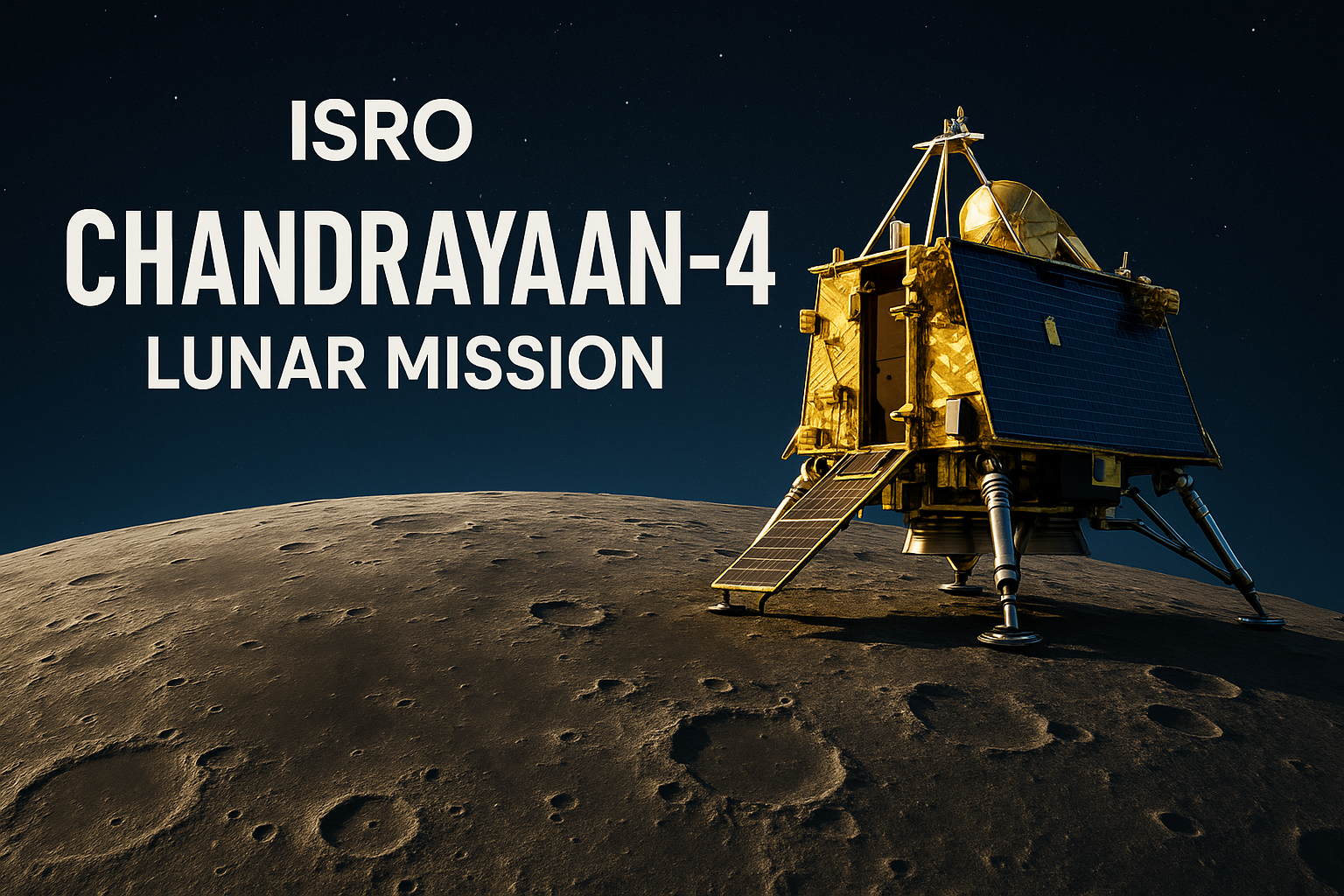
India is steadily advancing its space ambitions as ISRO begins preparations for the Chandrayaan-4 mission, marking the next major step in the country’s lunar exploration journey. After the successful Chandrayaan-3 landing, ISRO is now focusing on strengthening mission reliability through advanced lander and rover technologies.
Chandrayaan-4 is not just another Moon mission. It represents India’s long-term commitment to sustainable and technology-driven space exploration.
What Is the Chandrayaan-4 Mission?
Chandrayaan-4 is ISRO’s upcoming lunar mission designed to test and validate next-generation technologies required for future Moon missions. The mission focuses on improving soft-landing precision, rover mobility, surface operations, and overall mission durability.
Unlike earlier missions, Chandrayaan-4 places greater emphasis on technology readiness rather than only scientific experiments. The experience gained from previous missions will play a key role in shaping this advanced lunar project.
Why Chandrayaan-4 Is Important for India
Chandrayaan-4 plays a crucial role in India’s evolving space roadmap. It strengthens the foundation for more complex missions by improving critical systems related to landing safety, navigation, and long-term surface operations.
India’s expanding space vision can also be seen through missions like ISRO Aditya-L2 & Shukrayaan Missions 2025, which highlight the country’s parallel efforts in solar and planetary exploration. Together, these missions reflect ISRO’s shift from isolated achievements to a connected and future-oriented exploration strategy.
New Lander and Rover Under Testing
ISRO has already begun extensive testing of Chandrayaan-4’s lander and rover systems. These tests are aimed at ensuring higher mission safety and improved performance under harsh lunar conditions.
Lander Improvements
The new lander design focuses on better shock absorption, improved hazard detection sensors, and enhanced descent control systems. These upgrades are essential for achieving safer and more precise landings on uneven lunar terrain.
Rover Enhancements
The rover under development features improved wheel mechanisms, advanced navigation software, and greater autonomy. These enhancements will allow the rover to explore larger areas of the Moon’s surface and operate more efficiently over longer durations.
How Chandrayaan-4 Builds on Previous ISRO Missions
Chandrayaan-4 builds directly on the knowledge gained from India’s earlier lunar missions. ISRO is applying lessons learned from Chandrayaan-3 to develop systems that are more reliable, adaptable, and mission-ready.
This step-by-step approach aligns with India’s broader space strategy, which includes ambitious projects under ISRO’s upcoming space missions aimed at expanding the nation’s presence beyond Earth orbit.
Chandrayaan-4 and India’s Long-Term Space Vision
Chandrayaan-4 supports India’s long-term goals in space science and exploration. The mission contributes to preparations for future lunar research, deep-space missions, and advanced technological capabilities.
India’s progress in space technology is becoming increasingly interconnected, with missions like ISRO Aditya-L2 & Shukrayaan Missions 2025 demonstrating how solar, planetary, and lunar exploration efforts are being developed as part of a unified roadmap.
Expected Timeline and Mission Outlook
ISRO has not yet announced an official launch date for Chandrayaan-4. The mission is currently undergoing multiple testing and review phases to ensure technical readiness and mission safety.
ISRO’s approach prioritizes precision, reliability, and long-term success over rapid deployment, ensuring that each mission strengthens the next.
Final Thoughts
Chandrayaan-4 represents a significant milestone in India’s space journey. By refining lander and rover technologies, ISRO is laying the groundwork for sustained lunar exploration and future interplanetary missions.
As part of a broader ecosystem that includes ISRO Aditya-L2 & Shukrayaan Missions 2025, Chandrayaan-4 highlights India’s steady rise as a global leader in space science and technology.