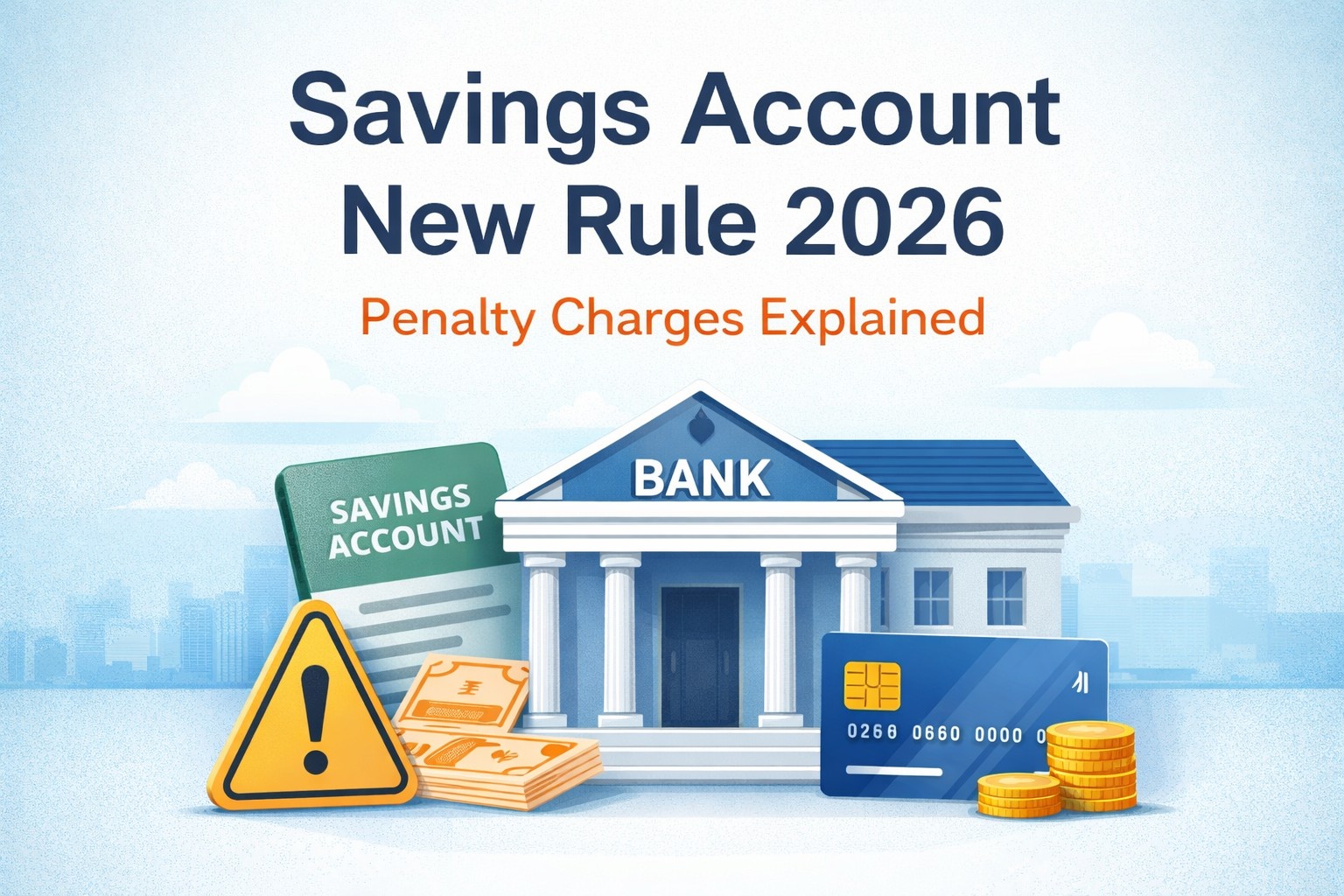
Savings accounts are considered the most basic and safest banking option for Indians. Almost every individual, whether salaried, self-employed, or retired, maintains at least one savings account. However, Savings Account New Rules coming in 2026 may change how banks treat inactive or non-compliant accounts.
Under the new banking guidelines, banks may start charging penalties if customers ignore certain mandatory rules related to minimum balance, KYC updates, and account activity. If you are not aware of these changes, you could lose money without realizing it.
This article explains the Savings Account New Rule 2026, possible penalties, and what you should do to avoid unnecessary charges.
What Is the Savings Account New Rule 2026?
From 2026, banks in India are expected to tighten rules related to savings account maintenance. These changes aim to reduce inactive accounts, improve compliance, and align with updated RBI norms.
The new rules mainly focus on:
- Minimum balance requirements
- KYC compliance
- Account inactivity
- Transaction monitoring
Ignoring these rules may result in penalties or restrictions on your savings account.
Major Changes in Savings Account Rules (2026)
1. Penalty for Not Maintaining Minimum Balance
Banks may impose stricter penalties if you fail to maintain the required minimum average balance.
- Urban and metro accounts may require higher balances
- Penalty amounts may increase compared to previous years
- Zero-balance accounts may have limited features
If your balance remains below the limit for long periods, charges may be deducted automatically.
2. Mandatory KYC Update
Incomplete or outdated KYC is one of the biggest reasons accounts face restrictions.
Under the new rule:
- Banks may freeze debit transactions
- Interest credit may be stopped temporarily
- Penalties may apply if KYC is ignored for long
Updating KYC on time will be extremely important in 2026.
3. Inactive Savings Account Charges
If your savings account has:
- No transactions for 12–24 months
- No balance maintenance
- No customer interaction
Banks may classify it as inactive or dormant, leading to:
- Reactivation charges
- Service limitations
- Possible penalty deductions
4. Increased Monitoring of Transactions
Banks may monitor unusual transactions more closely:
- Sudden high-value deposits
- Irregular withdrawals
- Repeated failed transactions
This is mainly for fraud prevention, but it may cause temporary holds or verification requests.
How These New Rules Can Affect You
If ignored, the Savings Account New Rule 2026 can lead to:
- Loss of money due to penalties
- Account freeze or restrictions
- Delays in accessing your own funds
- Reduced interest benefits
Even small penalties, if repeated, can add up over time.
What Should Savings Account Holders Do in 2026?
To stay safe and penalty-free, follow these steps:
- Maintain the required minimum balance
- Update KYC details immediately
- Use the account at least once every few months
- Monitor bank messages and emails
- Keep contact details updated with the bank
Being proactive will help you avoid unnecessary charges.
Better Alternatives to Keeping Excess Money in Savings Accounts
Savings accounts offer low interest rates, which may not beat inflation. Instead of keeping large amounts idle, consider safer alternatives.
You can explore BEST FIXED DEPOSIT ALTERNATIVES IN INDIA (2026) to find options that offer:
- Better returns
- Low risk
- More flexibility
(👉 Internal link add here)
Final Thoughts
The Savings Account New Rule 2026 is a reminder that even basic bank accounts now require attention. While savings accounts remain safe, ignoring updated rules can result in penalties and inconvenience.
Staying informed, compliant, and proactive will help you protect your money and avoid unnecessary losses.
FAQs
Will banks really charge penalties on savings accounts in 2026?
Yes, banks may charge penalties for minimum balance failures, inactive accounts, or incomplete KYC.
Can a savings account be frozen?
Yes, accounts with incomplete KYC or suspicious activity may face temporary restrictions.
Is it safe to keep large money in savings accounts?
Savings accounts are safe but offer low returns. Diversifying funds is often a better option.