
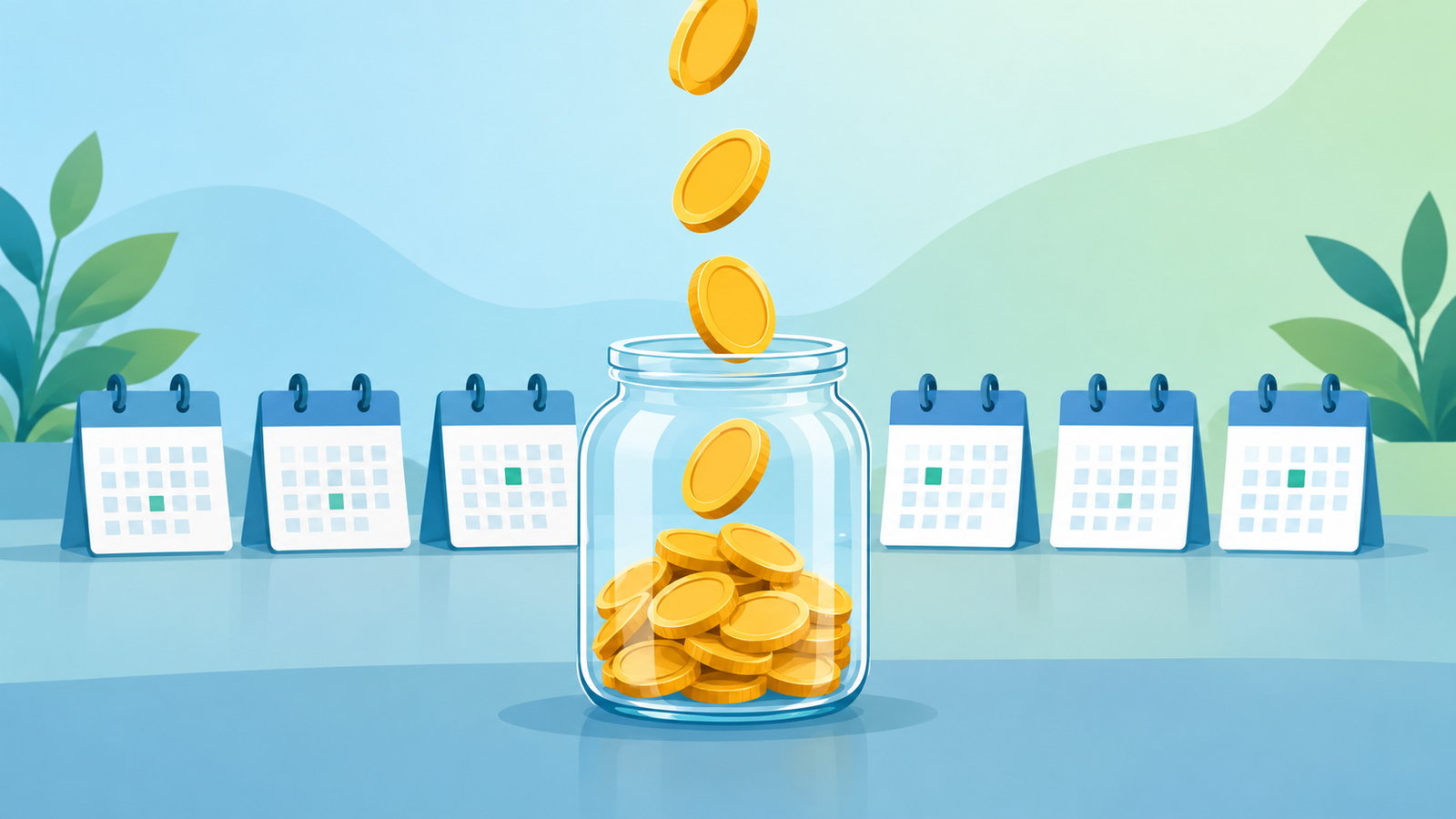
Dollar-cost averaging is an investing method where you put the same fixed amount of money into an investment on a regular schedule, such as $100 every month, no matter what the price is. Instead of trying to guess the perfect moment to buy, you spread your purchases over time. It is one of the most common habits of long-term investors, and it is the idea behind most workplace retirement plan contributions around the world.
Last updated: October 30, 2026
What Is Dollar-Cost Averaging?
With dollar-cost averaging, you decide on a fixed amount and a fixed schedule, then invest that amount every time, whether the market is up, down or flat. Because the amount of money stays the same, you automatically buy more shares when prices are low and fewer shares when prices are high.
The goal is not to beat the market. The goal is to remove the pressure of timing. Most people cannot predict when prices will fall or rise, and waiting for a “perfect” entry often means never starting at all.
How Dollar-Cost Averaging Works
- Pick an amount you can afford. Choose a sum that does not touch your bills or your emergency fund.
- Pick a schedule. Weekly, every two weeks or monthly all work. Many people match it to payday.
- Pick one or two diversified investments. A broad index fund is a common choice.
- Invest on schedule, every time. Do not skip a month because prices fell. That is when your fixed amount buys the most shares.
Dollar-Cost Averaging Example: A Market That Dips and Recovers
Imagine you invest $100 a month for six months, while the price of one share moves like this. All numbers are simple illustrations, not real market data.
| Month | Share price | You invest | Shares bought |
|---|---|---|---|
| 1 | $20 | $100 | 5.00 |
| 2 | $16 | $100 | 6.25 |
| 3 | $10 | $100 | 10.00 |
| 4 | $12 | $100 | 8.33 |
| 5 | $16 | $100 | 6.25 |
| 6 | $20 | $100 | 5.00 |
| Total | $600 | 40.83 |
The simple average of the six prices is about $15.67. But because you bought more shares when the price was low, your average cost per share is only about $14.69 ($600 ÷ 40.83 shares). At the end, the price is back at $20, so your 40.83 shares are worth about $816.67. If you had put all $600 in at the start at $20, you would own 30 shares worth $600 at the end, with no gain at all.
When Dollar-Cost Averaging Does Not Win: A Steadily Rising Market
Now imagine the price climbs steadily from $10 to $15 over the same six months.
| Scenario | Total invested | Value at the end | Gain |
|---|---|---|---|
| Dip and recovery: monthly $100 | $600 | $816.67 | +$216.67 |
| Dip and recovery: lump sum | $600 | $600.00 | $0 |
| Steady rise: monthly $100 | $600 | $733.89 | +$133.89 |
| Steady rise: lump sum | $600 | $900.00 | +$300.00 |
This is the honest trade-off. When prices fall first and recover, dollar-cost averaging looks smart. When prices rise steadily, investing everything on day one wins, because more of your money is invested for longer. Nobody knows in advance which path the market will take.
Dollar-Cost Averaging vs Lump-Sum Investing
Studies of long historical periods have often found that lump-sum investing comes out ahead more often than not, simply because markets tend to rise over time. Still, most people do not have a lump sum. They earn a salary and invest from every paycheck, which is dollar-cost averaging by nature. If you do have a large sum, a middle path is to split it into a few equal parts over several months.
Advantages of dollar-cost averaging
- It builds a habit and removes the need to time the market.
- It reduces the regret of investing everything right before a drop.
- It works with small amounts, as shown in our guide on how to start investing with little money.
- It can be automated, so emotions matter less.
Drawbacks of dollar-cost averaging
- In a rising market, you may earn less than a lump sum.
- Frequent small purchases can add fees if your platform charges per trade.
- It does not protect you from losses if an investment keeps falling for good.
Who Should Use Dollar-Cost Averaging?
It suits people who invest from regular income, beginners who feel nervous about volatility, and anyone building long-term wealth through funds. It works best with diversified investments, such as an index fund or an ETF (see ETF vs mutual fund), rather than a single risky stock that may never recover.
How to Start Dollar-Cost Averaging in 5 Steps
- Build a small emergency cushion first.
- Choose a fixed amount, even a small one.
- Open an account with a low-cost, regulated provider in your country.
- Set up an automatic transfer and automatic purchase on the same date each period.
- Review once or twice a year, not every day. Over many years, compound interest does the heavy lifting.
Common Mistakes to Avoid
- Stopping when the market falls. That defeats the whole idea.
- Choosing a weak investment. Averaging a falling price on a poor company only averages your losses.
- Ignoring fees. Choose a platform with low or no trading costs.
- Expecting guaranteed profit. It lowers timing risk, not market risk.
Frequently Asked Questions
Is dollar-cost averaging good for beginners?
Yes. It is simple, it needs no market forecast and it builds a steady habit. The U.S. SEC’s Investor.gov site is a free place to learn the basics of investing.
How often should I invest?
Choose the schedule that matches how you are paid. The exact frequency matters far less than staying consistent.
Does dollar-cost averaging work with dividends?
Yes. You can reinvest payouts as well. Our guide on how dividends work explains this clearly.
Final Thoughts
Dollar-cost averaging will not guarantee profit or beat every other strategy, but it makes investing calmer and more regular. If you want to understand where your money goes, read how the stock market works next.
Disclaimer: This article is for general education only and is not financial advice. All examples use made-up numbers. Investments can lose value. Consider speaking with a licensed financial adviser about your own situation.