
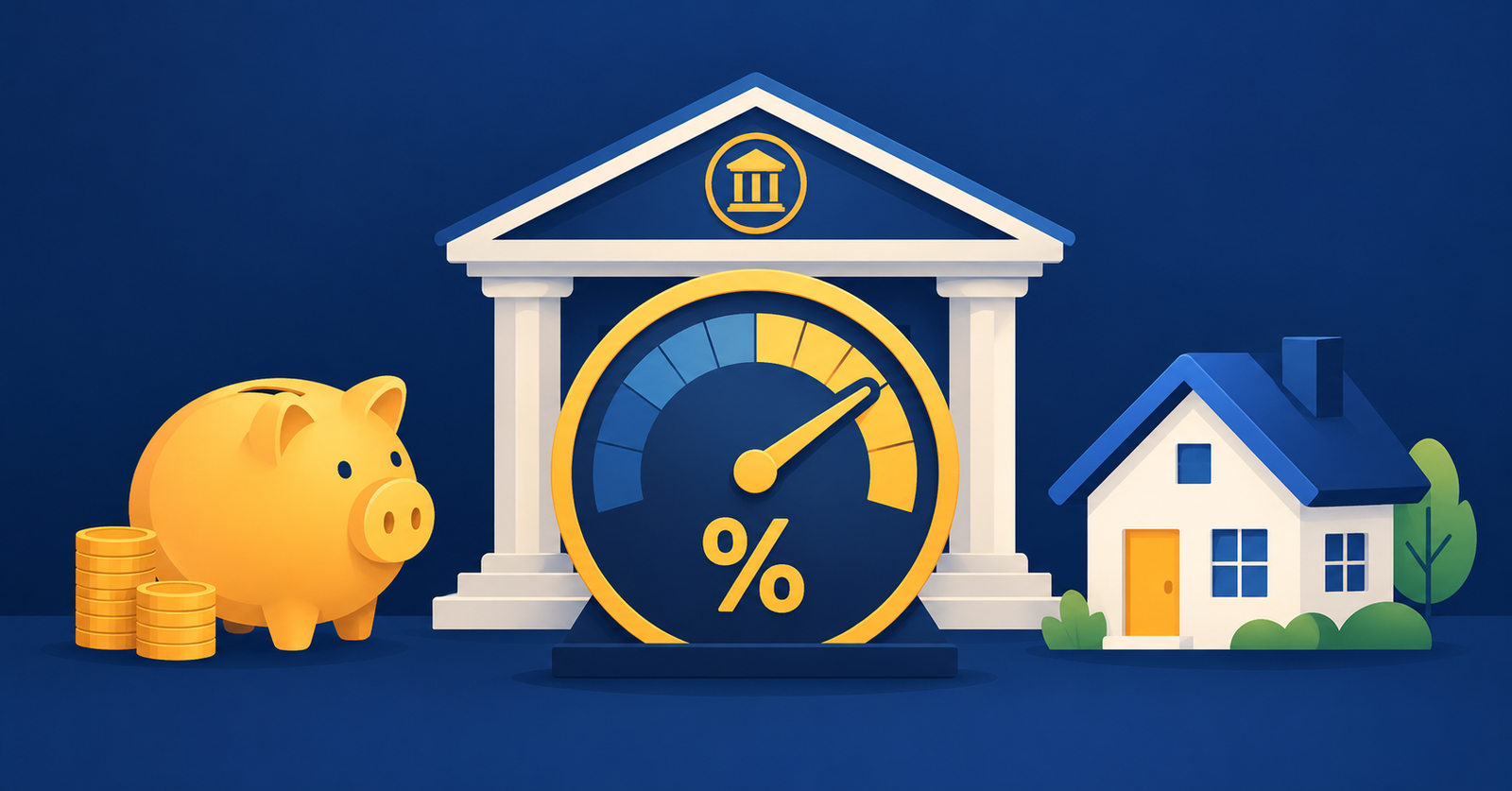
How do interest rates work? An interest rate is the price of using money. When you borrow, you pay it to the lender. When you save, the bank pays it to you. Rates are not fixed forever: they rise and fall with the economy, and those changes reach your savings, your loans, your mortgage and even the value of your bonds. This guide explains who sets interest rates, why they move, and what it means for your money, using simple examples that work in any currency.
Last updated: October 28, 2026
What Is an Interest Rate?
An interest rate is a percentage of an amount of money, charged or paid for a period of time, usually one year. If you borrow 1,000 at 10% a year, the cost of using that money for a year is 100. If you save 1,000 at 3% a year, the bank pays you 30.
The same idea sits behind every financial product: a loan, a credit card, a mortgage, a savings account or a bond. The only difference is which side of the deal you are on, the borrower or the saver.
How Do Interest Rates Work? Who Sets Them?
There is not one single interest rate. There is a chain, and it starts with the central bank.
- The central bank sets a policy rate. This is the base rate that banks use when they lend to each other. In the United States it is the federal funds rate, set by the Federal Reserve. Other countries have their own central banks and their own policy rates.
- Banks build their own rates on top. A bank adds a margin for its costs, profit and risk, so the rate you see is higher than the policy rate.
- Your personal rate depends on you. A strong credit score, a stable income, a bigger down payment or collateral usually means a lower rate. Riskier borrowers pay more.
For a clear official explanation, see the Federal Reserve’s page on monetary policy: its goals and how it works.
Why Do Interest Rates Rise and Fall?
When Rates Rise
Central banks usually raise rates when prices are rising too fast. Higher rates make borrowing more expensive, so people and companies spend less, demand cools and inflation slows. This is why inflation and interest rates are so closely linked. Read more in our guide on how inflation quietly eats your savings.
When Rates Fall
When the economy is weak or unemployment is rising, central banks usually cut rates. Cheaper borrowing encourages spending and investment, which can help the economy recover. The trade-off is that savers earn less and, if rates stay low for too long, prices can start rising again.
Other Forces Behind Rate Changes
Supply and demand also matter. If many people want to borrow and few want to save, rates tend to rise. A borrower’s credit risk, the length of the loan and expectations about future inflation all push rates up or down too.
A Simple Example: What One Percentage Point Means
Small changes in rates can mean big changes in cost. Look at what a 1 percentage point rise (for example, from 6% to 7%) does to a loan:
| Situation | Amount | Extra interest after a 1-point rise (roughly, in the first year) |
|---|---|---|
| Personal loan | 10,000 | About 100 more per year |
| Car loan | 20,000 | About 200 more per year |
| Mortgage | 200,000 | About 2,000 more per year |
| Savings account | 10,000 | About 100 more earned per year (if the bank passes it on) |
The numbers are simple on purpose. Real loans reduce the balance over time, so the exact amount differs. But the pattern is clear: the bigger and longer the loan, the more a rate change matters.
How Interest Rate Changes Affect Your Money
| Area | When rates rise | When rates fall |
|---|---|---|
| Savings accounts | You usually earn more | You usually earn less |
| Loans and credit cards | Borrowing costs more | Borrowing costs less |
| Mortgages | Monthly payments for new or variable-rate loans go up | Payments for new or variable-rate loans go down |
| Bonds | Prices of existing bonds usually fall | Prices of existing bonds usually rise |
| Inflation | Tends to slow down | Can pick up if rates stay low |
Want to see the connections in detail? We explain each one in separate guides: how bonds work, how a mortgage works, how credit card interest (APR) works and how personal loans work.
Fixed vs Variable Interest Rates
- Fixed rate: the rate stays the same for the whole term, so your payment is predictable. You will not benefit if market rates fall.
- Variable (floating) rate: the rate moves with market rates. You may pay less when rates fall, but more when they rise.
Neither is always better. A fixed rate gives certainty, while a variable rate gives flexibility with risk.
How Can You Use Interest Rates to Your Advantage?
- When rates are high: prioritize paying down expensive debt, and look for a high-yield savings account to earn more on your cash.
- When rates are low: borrowing is cheaper, but avoid taking debt you do not need. Check whether refinancing an existing loan could save money.
- Always: compare the full cost of a loan, not just the monthly payment, and let your money grow with compound interest over time.
Nobody can predict rate changes perfectly, not even experts. So it is better to build a plan that works in both high-rate and low-rate times.
Frequently Asked Questions
Who decides interest rates?
The central bank sets the base (policy) rate. Commercial banks then set their own rates for savings and loans, based on that rate, their costs and your risk.
Why are credit card interest rates so high?
Credit cards are unsecured, meaning there is no asset for the lender to claim if you do not pay. The lender takes more risk, so it charges a higher rate.
Do higher interest rates always mean a weaker economy?
No. Rates are often raised to cool down inflation in a strong economy. They are cut when the economy needs support.
Final Thoughts
Interest rates are the price of money, and they quietly shape your savings, your debts and your investments. Understand the chain from the central bank to your own loan or account, compare the full cost before you borrow, and plan for rates to change.
Disclaimer: This article is for general education only and is not financial, investment or tax advice. Interest rates, rules and products differ by country and by lender, and examples use simple numbers, not real offers. Please research carefully or speak with a licensed financial adviser before making financial decisions.