Last updated: October 27, 2026
How do bonds work? In simple terms, a bond is a loan that you give to a government or a company. In return, the borrower promises to pay you regular interest and to give back your original money on a fixed date. That is why bonds are often called “fixed income” investments: the payments are set in advance, unlike the ups and downs of company shares. In this guide, you will learn what a bond is, how bond prices and yields move, which risks to watch for, and how bonds compare with stocks.
What Is a Bond? The Simple Idea
Imagine a friend wants to borrow 1,000 to start a small business. They write you a note that says, “I will pay you 50 every year, and in five years I will return your 1,000.” A bond is exactly that kind of note, only on a much bigger scale.
Governments issue bonds to pay for roads, schools and public services. Companies issue bonds to grow their business. When you buy a bond, you become the lender, and the issuer becomes the borrower who owes you money.
The Key Parts of a Bond
Every bond is described using a few standard terms. Once you know these five, most bond news starts to make sense.
| Term | What it means | Simple example |
|---|---|---|
| Face value | The amount the issuer repays at the end of the loan | 1,000 |
| Coupon rate | The yearly interest, shown as a percentage of face value | 5% = 50 per year |
| Maturity date | The day the loan ends and the face value is repaid | 5 years from issue |
| Issuer | The government or company that borrowed the money | A national government |
| Yield | Your actual return, based on the price you paid | Changes as the price changes |
How Do Bonds Work Step by Step? A Simple Example
Here is a basic example with round numbers, so the idea is easy to follow:
- A government issues a 5-year bond with a face value of 1,000 and a 5% coupon.
- You buy the bond for 1,000.
- Every year you receive 50 in interest. Some bonds pay twice a year instead.
- After 5 years, the bond matures and you get your 1,000 back.
In total, you received 250 in interest plus your original 1,000, so you earned 250 on a 1,000 investment. You can also sell a bond before it matures at its current market price, and that brings us to the most confusing part for beginners: why prices move.
Why Bond Prices Move When Interest Rates Change
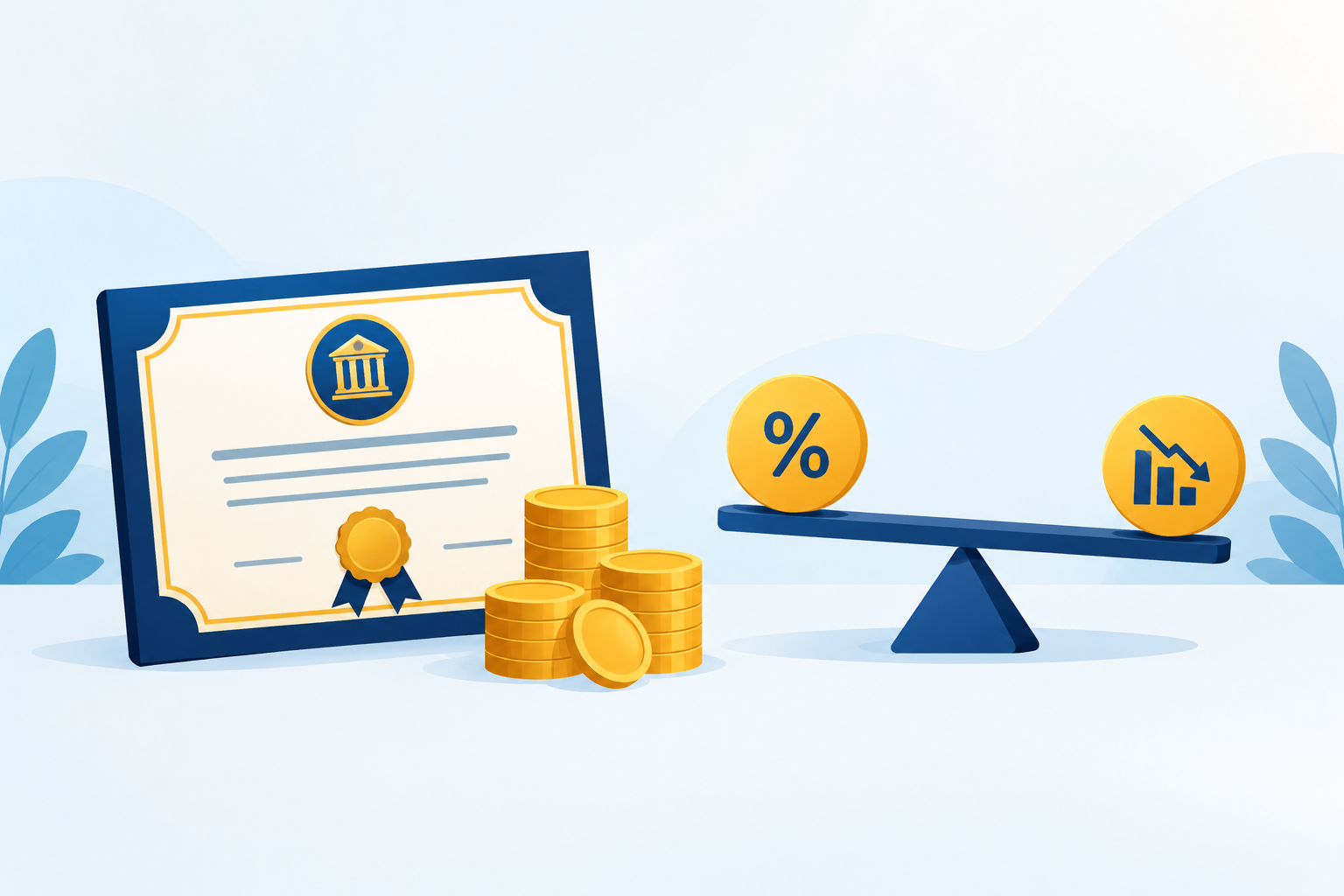
Think of a seesaw. When interest rates go up, the prices of existing bonds go down. When interest rates go down, the prices of existing bonds go up.
Here is why. Suppose you own the 5% bond from our example. Then new bonds start paying 6%. Nobody wants to pay the full 1,000 for your 5% bond when a new one pays more, so the price of your bond falls until its return looks competitive again. Now imagine the opposite: new bonds only pay 4%. Your 5% bond suddenly looks attractive, so buyers will pay more than 1,000 for it.
If you hold a bond until maturity, you still receive the face value back, as long as the issuer pays. So price swings matter most when you sell early or when you invest through a bond fund.
What Is Bond Yield?
The coupon is fixed, but your yield depends on the price you pay. Using the same bond with a 50 yearly coupon:
- If you buy it at 900, the current yield is 50 ÷ 900, which is about 5.6%.
- If you buy it at 1,100, the current yield is 50 ÷ 1,100, which is about 4.5%.
So when the price goes down, the yield goes up, and the other way round. A more complete measure is called yield to maturity, which also counts the gain or loss you make when the bond is repaid at face value. For a beginner, remember one rule: price and yield move in opposite directions.
Main Types of Bonds
- Government bonds: issued by national governments, such as U.S. Treasuries. They are generally considered lower risk, so they usually pay lower interest.
- Corporate bonds: issued by companies. They usually pay more than government bonds because the risk that the company cannot repay is higher.
- Local government (municipal) bonds: issued by cities or regions in some countries to fund public projects.
- High-yield bonds: issued by borrowers with weaker finances. They pay high interest, but the chance of default is also higher.
- Bond funds and ETFs: baskets that hold many bonds at once. If you want to understand how these differ, read our guide on ETF vs mutual fund.
The Main Risks of Bonds
Bonds are often described as calmer than stocks, but they are not risk-free. These are the four risks to know:
| Risk | What it means |
|---|---|
| Interest rate risk | If rates rise, the market price of your bond can fall. |
| Credit (default) risk | The issuer may fail to pay interest or return your money. |
| Inflation risk | If prices rise faster than your bond’s interest, your buying power shrinks. See how inflation quietly eats your savings. |
| Liquidity risk | Some bonds are hard to sell quickly at a fair price. |
Bonds vs Stocks: A Quick Comparison
Many beginners ask whether they should buy bonds or stocks. They do different jobs, as this table shows. If you are new to shares, start with our simple guide on how the stock market works.
| Feature | Bonds | Stocks |
|---|---|---|
| What you own | A loan to the issuer | A small part of a company |
| Income | Fixed interest payments | Dividends, which are not guaranteed |
| Typical risk | Usually lower | Usually higher |
| Typical growth | Usually lower | Usually higher over the long term |
| If the company fails | Bondholders are paid before shareholders | Shareholders are paid last and may get nothing |
How Do Bonds Fit Into Your Money Plan?
There is no single right mix. In general, people with many years before they need their money often hold more stocks for growth. People who will need the money soon often hold more bonds for stability. Your goals, your time horizon and how much ups and downs you can handle all matter.
You do not have to pick individual bonds. A bond index fund or ETF holds hundreds of bonds at once, which spreads the risk. Our guide on what an index fund is explains the idea, and our article on how compound interest works shows why reinvesting the interest you earn can make a big difference over time. If you are starting small, read how to start investing with little money. For money you may need within a year, a high-yield savings account can be a simpler option than bonds.
For a plain-language overview of different investment types, you can also read the Investor.gov guide to investment products, published by the U.S. Securities and Exchange Commission.
Frequently Asked Questions About Bonds
Can you lose money on bonds?
Yes. You can lose money if you sell a bond for less than you paid, or if the issuer cannot repay. Holding a high-quality bond to maturity lowers the first risk, but it never removes every risk.
Are bonds better than a savings account?
Not always. Bonds can pay more interest, but their prices can change and some carry default risk. A savings account is simpler and is usually better for money you need soon.
How do I buy bonds?
Most people buy bonds through a brokerage account, either one bond at a time or through a bond fund or ETF. In some countries you can also buy government bonds directly from the government. Rules and costs differ by country, so check with a licensed provider where you live.
Disclaimer: This article is for general education only and is not financial, investment or tax advice. Examples use simple numbers and are not real offers. Bond rules, taxes and risks differ by country and by issuer. Please research carefully or speak with a licensed financial adviser before you invest.