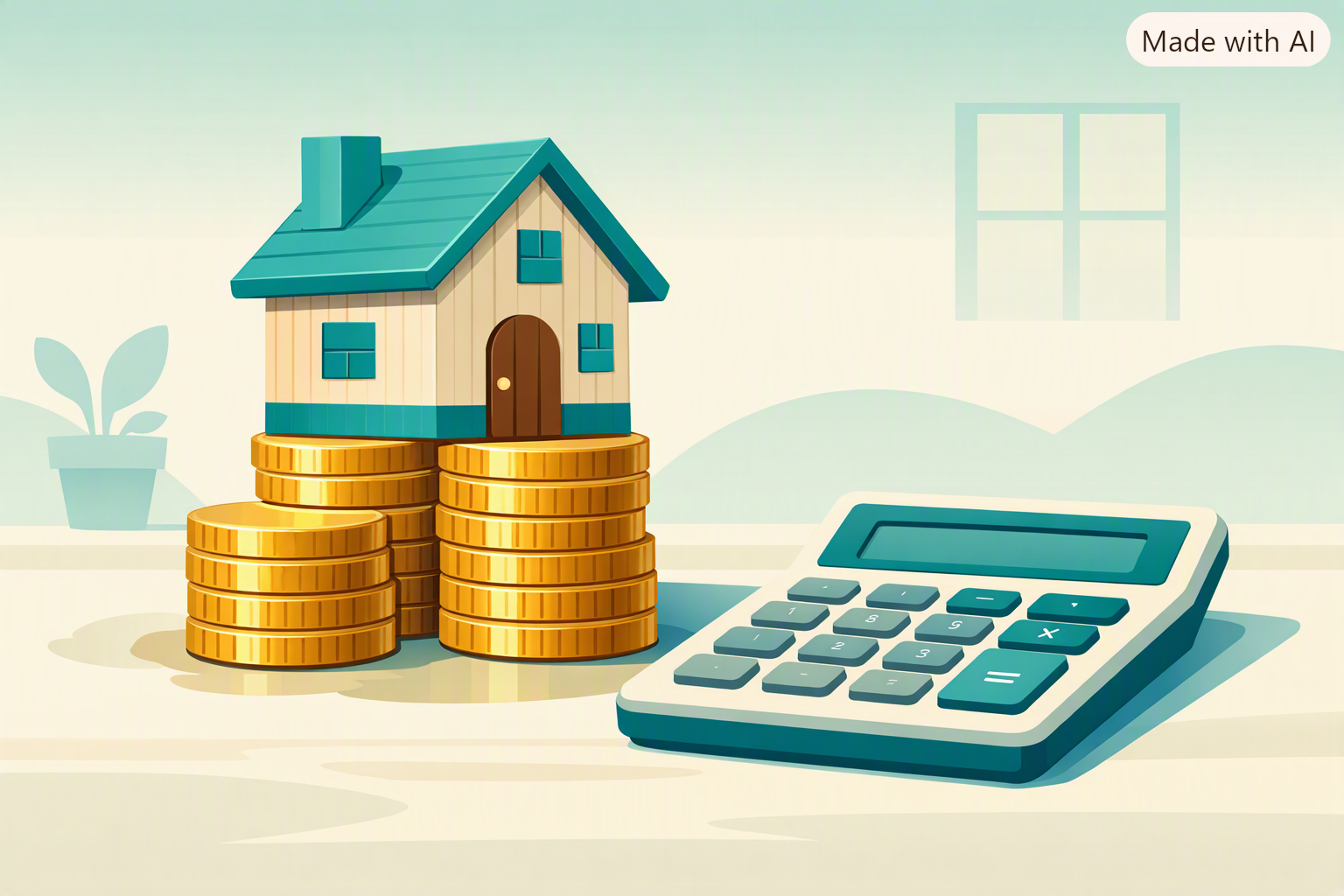
How does a mortgage work? In simple terms, a mortgage is a loan from a bank or lender that you use to buy a home, and you repay it in monthly installments over many years, usually 15 or 30. The home itself is the security for the loan, which means the lender can take it back if you stop paying. Once you understand this one idea, every other mortgage term becomes much easier to follow.
A quick note before we start: the examples below use US-style home loans with round numbers, because they are easy to follow. Rules, rates and fees differ by country and by lender, so treat the numbers as teaching examples, not offers.
The Basic Idea: Borrow Now, Repay Slowly
Very few people can pay the full price of a house in cash. So a lender pays the seller on your behalf, and you repay the lender over time with interest. Interest is simply the fee you pay for borrowing money. You usually pay a part of the price yourself as a down payment, and the mortgage covers the rest.
For example, if a home costs $375,000 and you put down $75,000, you need a mortgage of $300,000. The longer the repayment period, the smaller each monthly payment, but the more total interest you pay.
What Is Inside Your Monthly Mortgage Payment?
Many beginners think the payment is just “the loan divided by the months”. In reality it has up to four parts.
Principal
This is the part that reduces the amount you originally borrowed. Every rupee, dollar or pound of principal you repay brings you closer to owning the home fully.
Interest
This is the lender’s fee, calculated on the balance you still owe. Because the balance is highest at the start, interest takes the biggest share of your early payments.
Property taxes
In many places the lender collects your yearly property tax in small monthly amounts and pays the government for you.
Homeowners insurance
Lenders usually require insurance against damage such as fire. That cost is often added to the monthly payment too.
A Real Example: A $300,000 Loan at 6.5%
Let us take a $300,000, 30-year fixed mortgage at 6.5%. Using the standard loan formula, the monthly payment for principal and interest comes to about $1,896. Here is where your very first payment goes:
| Part of first payment | Approximate amount |
|---|---|
| Interest | $1,625 |
| Principal | $271 |
| Total (without taxes and insurance) | $1,896 |
Surprising, right? In month one, more than 85% of your payment is interest. This process is called amortization. Over the years the balance falls, the interest part shrinks, and the principal part grows. By the final years, almost the entire payment reduces the loan.
Over 30 years you would pay roughly $683,000 in total, which means about $383,000 is interest alone. That is why the length of the loan matters so much.
15-Year vs 30-Year Mortgage
Choosing the loan term is the first big decision. Shorter loans usually come with lower interest rates, but the monthly payment is higher. These figures use sample rates for the same $300,000 loan.
| Feature | 30-year at 6.5% | 15-year at 5.75% |
|---|---|---|
| Monthly payment (principal and interest) | about $1,896 | about $2,491 |
| Total interest paid | about $383,000 | about $148,000 |
| Best for | Lower monthly pressure | Saving interest, fast ownership |
The 15-year loan costs about $595 more every month, yet it saves roughly $235,000 in interest. If your income is stable and your budget allows it, the shorter loan is powerful. If not, the 30-year loan keeps your monthly life comfortable, and you can still make extra payments whenever you can.
Fixed-Rate vs Adjustable-Rate Mortgage
The second big decision is the type of interest rate.
Fixed-rate mortgage
The interest rate stays the same for the full loan term. Your principal and interest payment never changes, which makes planning easy.
Adjustable-rate mortgage (ARM)
The rate is fixed only for a starting period, for example 5 years in a “5/1 ARM”, and then it can change every year based on market rates. The starting rate is often lower, but the risk is higher.
Here is a simple comparison on the same $300,000 loan, using sample numbers:
| Feature | Fixed-rate (30 years) | 5/1 ARM (30 years) |
|---|---|---|
| Starting rate | 6.5% | 5.75% |
| Payment in years 1 to 5 | about $1,896 | about $1,751 |
| Payment if the rate rises 2 points after year 5 | still about $1,896 | about $2,102 |
| Main risk | Paying a higher rate from day one | Payment can jump later |
The ARM saves about $145 a month at first, but if rates rise, the payment can become roughly $206 higher than the fixed loan. An ARM can make sense if you are confident you will sell or refinance before the fixed period ends. If you plan to stay for a long time and want certainty, a fixed rate is usually the safer path.
How Much Mortgage Can You Really Afford?
Lenders often look at your debt-to-income ratio, which compares your monthly debt payments with your monthly income. A commonly quoted guideline is to keep housing costs around 28% of your gross income and total debts around 36%, though lenders vary. Your own comfort matters more than the maximum a bank approves.
A smart check is to place the payment inside your budget. If you use the 50/30/20 budget rule, your housing cost should fit comfortably inside the “needs” half. Also, knowing your net worth shows how strong your starting position is.
Costs Beyond the Monthly Payment
Buying a home brings extra costs that surprise many first-time buyers:
- Down payment: often 3% to 20% of the price, depending on the loan type.
- Closing costs: fees for the lender, valuation, legal work and registration, commonly estimated at 2% to 5% of the loan.
- Mortgage insurance: some loans require it when your down payment is below 20%.
- Maintenance: repairs, a new roof, a broken water heater. Keep a separate fund for them.
That last point is why an emergency fund matters even more after you buy a home.
Simple Steps Before You Apply
- Check your credit score. A higher score usually earns a lower rate. Our guide on how to improve your credit score shows practical steps.
- Reduce expensive debt. High-interest balances reduce how much a lender will approve. Read how credit card interest adds up, then plan repayment.
- Save the down payment and extra costs. A high-yield savings account can help this money grow safely while you wait.
- Compare several lenders. Even a small rate difference changes the total interest by thousands.
- Read official guidance. The Consumer Financial Protection Bureau’s home-buying tools explain loan estimates and closing documents in plain language.
Frequently Asked Questions
Can I pay off a mortgage early?
Often yes, and it saves interest. But some loans charge a prepayment penalty, so check the terms before signing.
Is a bigger down payment better?
It lowers your loan, your interest and sometimes your rate. But do not drain your savings completely, because you still need a safety cushion.
What happens if I cannot pay?
Talk to your lender early. Missed payments can lead to penalties and, in the worst case, the lender selling the home to recover its money.
Final Thoughts
A mortgage is not scary once you see its parts: the amount you borrow, the interest rate, the loan term and the extra costs around it. Compare a fixed and an adjustable rate honestly, choose a payment you can carry even in a bad year, and keep your savings and credit healthy. A calm, well-planned decision today can save you tens of thousands over the life of the loan.
Disclaimer: This article is for general education only and is not financial, legal or tax advice. Mortgage rules, rates and fees differ by country and lender, and the numbers shown are simplified examples. Please consult a licensed professional before making any borrowing decision.